INNOQ

Digital sovereignty starts with resilient software architecture

Digital sovereignty means preserving your company's ability to act — even when political, legal, or economic conditions change. You can achieve it by making deliberate decisions about the dependencies you take on and the alternatives available to you. The key lever is your software architecture.

Key Takeaways

View Executive Summary
  • Make sovereignty part of your architecture strategy: It determines whether your company can keep operating when the unexpected happens and strengthens your business continuity.

  • Choose dependencies deliberately: Make-or-buy, operating model, vendor selection — sovereignty means having options, not cutting yourself off.

  • Know your alternatives: Alternative options reduce cost risk.

  • Use AI on your own terms: Differentiate by use case. Where do you need US models, and where are open-weights alternatives enough?

  • Invest in team capability, not just technology: Sovereignty comes from the ability to solve problems.

  • Build compliance into the architecture: Whether it is GDPR, NIS2, DORA, or KRITIS, organizations that anchor data control and portability in their software architecture can respond flexibly to new requirements.

Every digital dependency is a choice. The only question is whether you made it consciously.

GIL BRETH
GIL BRETH
Senior Consultant at INNOQ

Who is this for?

Digital sovereignty affects multiple levels of your organization. Depending on who owns which decisions, the levers are different.

Strategic decision-makers

CTO, CIO, executive management:
You oversee IT strategy, vendor relationships, and compliance, with the goal of keeping the business resilient as conditions change. Digital sovereignty reduces risk, strengthens your negotiating position, and provides a solid foundation for regulatory compliance.

Architecture Leaders

Enterprise architects, architecture teams:
You shape your company's architecture strategy and, with it, a key lever for digital sovereignty. Your focus ranges from multi-cloud strategies and integration patterns to data sovereignty. You need to ensure that architectural decisions stay scalable, maintainable, and aligned with your business goals.

Delivery

Head of IT, engineering:
You are responsible for team enablement, operations, and day-to-day execution. Digital sovereignty matters to you because it cannot be achieved without in-house expertise. Your focus is on practical implementation, capability building, and driving incremental change without disruption.

Do you know your dependencies?

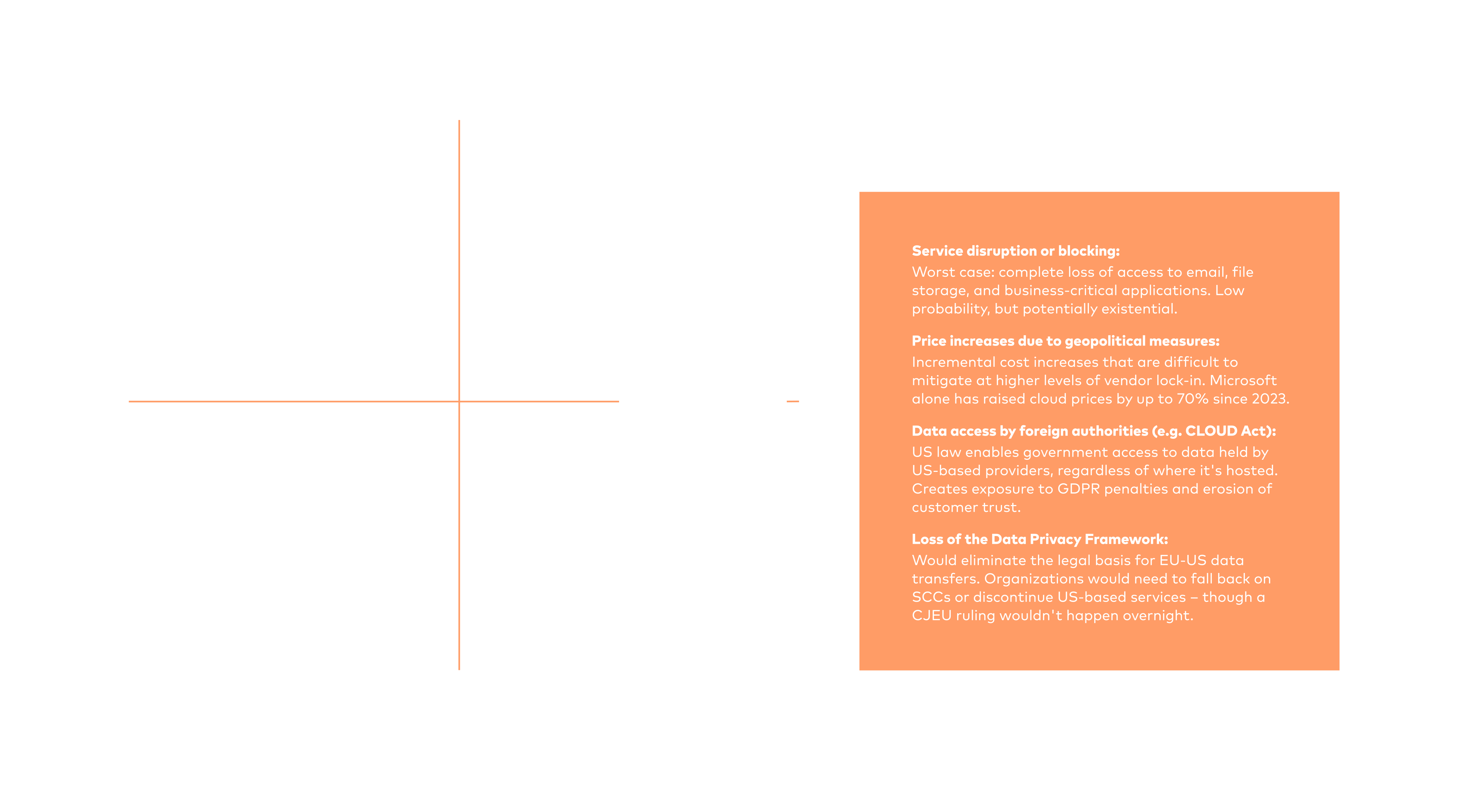
Over the past few years, European companies have outsourced large parts of their IT landscape to US cloud providers. The advantages were compelling: scalability, speed, innovation. But those decisions also created dependencies that are now turning into risks.

Risikomatrix

Where to take action

Digital sovereignty does not come from a single measure. The seven areas below show where architecture decisions make a concrete difference.

Build robust software architecture

Sovereignty starts with the structure of your systems. If you want to manage dependencies, you need a software architecture in which individual parts can change or be replaced independently.

Bounded contexts as a core principle: Bounded contexts from domain-driven design split your system landscape along business boundaries. Each area owns its own data and logic and communicates with other areas through defined interfaces. That limits how far dependencies can reach and preserves your ability to act.

Macro-architecture as a guardrail: Cross-cutting architecture principles ensure that your systems — whether custom-built or off-the-shelf — remain compatible at the interfaces that matter most. Event-driven communication, for example, creates loose coupling and makes individual building blocks replaceable without destabilizing the overall system.

Outcome: Your architecture becomes more resilient to change — whether that means new providers, shifting requirements, or regulatory pressure.

Get in touch

Create transparency

Without visibility, there is no control. Before you can reduce dependencies, you need to make them visible — both technically and from a business perspective.

Technical level: A software bill of materials (SBOM) shows which external components are in use. The prerequisite: keep the SBOM up to date and check it regularly for known vulnerabilities.

Business level: A capability map shows which business capabilities depend on which systems and providers. Enterprise architecture connects the IT landscape, business processes, and strategy.

Outcome: You know which services you use for what, where your data resides, and which business capabilities would be affected.

Get in touch

Avoid vendor lock-in

Digital sovereignty means making conscious decisions about where standard solutions are sufficient and where custom development is necessary — and choosing providers in ways that keep switching feasible.

Make make-or-buy a conscious decision: Whether you build software yourself or buy it depends on three questions:

  1. Does it differentiate us in the market?
  2. How high is the risk if we lose control?
  3. Can we switch providers?

Where software strengthens your core business, custom development is worth considering. Where it does not, standard software is often the right choice — provided the integration approach keeps switching costs low.

Evaluate providers against sovereignty criteria: Beyond functionality and cost, ask: How critical is the service to your core processes? How high is the lock-in risk? How resilient is the provider to geopolitical change? Review existing contracts for barriers to switching as well — the EU Data Act strengthens your position here.

Outcome: You enter dependencies deliberately, understand their risks, and can switch providers if needed.

Get in touch

Create technical options

You cannot avoid dependencies, but you can isolate them. The goal is not autarky. It is freedom of choice.

Ensure data control: Where does your sensitive data live? Who has access to it? Multi-cloud or hybrid strategies let you store data where it makes legal and strategic sense.

Increase platform independence: Container technologies such as Kubernetes improve portability at the application layer. Dependency on underlying cloud services such as storage, networking, or IAM remains and must be addressed separately.

Use open source selectively: Open-source solutions provide transparency, auditability, and the option to develop them further yourself. The benefit depends on having — or building — internal capability for maintenance and security.

Outcome: You create technical freedom of choice and reduce dependence on individual providers without giving up their strengths.

Get in touch

Use AI on your own terms

AI is making its way into more and more business processes. Anyone using it should understand the dependencies involved.

Understand dependencies: Chinese models refuse to answer politically sensitive questions. US models are powerful, but the data is subject to US law. In May 2025, a US court ordered OpenAI to retain even deleted chat data as part of a copyright case. That shows the reality: if you use US services, you do not have full control over what happens to your data.

Know the alternatives: Open-weights models such as those from Mistral can run on your own hardware. For document summarization, code assistance, or internal knowledge search, they deliver useful results. For complex reasoning, US models are still ahead for now.

Build capability step by step: Do not wait for perfect alternatives to appear. If you build capability today, you will be able to switch providers tomorrow on your own terms — instead of starting from scratch:

  1. Pilot project: Start with a low-risk use case such as meeting transcription or simple summaries.
  2. Build expertise: Connect AI models to internal data sources, for example, for knowledge search or document analysis.
  3. Choose consciously: For complex tasks, weigh the tradeoff: do you accept data flowing to US providers, or lower quality from local models?

Outcome: You use AI deliberately, understand the risks of different models, and can switch providers when necessary.

Get in touch

Build team capability

The best architecture decisions are worth little if you do not have the people to implement and evolve them.

Find the right benchmark for your context: “We are not Google” is something we often hear. True. But that should not be a reason to avoid building relevant capability. There is much to learn from the challenges large organizations face. What matters is adapting those lessons to your own needs.

Three levers:

  1. Keep structures simple: The less complexity baked into your processes, the faster your teams can respond to shifting requirements — whether that means switching providers or adapting to new regulations.
  2. Set meaningful goals: If teams understand why sovereignty matters to the business, they can make architecture decisions in that direction on their own.
  3. Invest in people: If you want to run Kubernetes, maintain open-source components, or implement multi-cloud strategies, you need teams that can do it — not just technology that promises it.

Outcome: Your teams can implement sovereignty goals on their own — not as a one-off project, but as a lasting capability.

Learn more: INNOQ Technology Briefing “Sociotechnical Architectures”

Get in touch

Build compliance and resilience into your architecture

Regulatory requirements for IT systems are increasing. At the same time, organizations need to stay operational when disruptions occur. Software architecture is a critical lever in making that possible.

Meet regulatory requirements: GDPR, NIS2, DORA, and critical infrastructure regulations all impose specific requirements for data management, resilience, and auditability. When data sovereignty and portability are built into your architecture, you can respond to new requirements without redesigning everything from scratch.

Prepare for business continuity: What happens if a core service fails or a vendor can no longer deliver? Disaster recovery scenarios, documented dependencies, and tested fallback paths make the difference between having a contingency plan on paper and being able to act when it matters.

Outcome: You are better prepared for regulatory demands and able to respond effectively in a crisis because compliance and resilience are built into your architecture.

Get in touch

Read articles

Digital sovereignty is achievable. In these articles, our colleagues explain how to make it happen across different areas.

Digital sovereignty is achievable — we show you how!

We support you on your path to digital sovereignty, wherever you are today.

GIL BRETH
GIL BRETH
Senior Consultant at INNOQ
Get in touch
Stage 1

Sovereignty Check

You know your dependencies. We help you assess what they mean.

What we do:

  • Assess your current dependencies and the risks they create
  • Identify concrete alternatives and realistic migration scenarios
  • Highlight immediate actions that can have a significant impact with limited effort

Outcome: You know which dependencies are critical, what alternatives are available, and what to tackle first.
Effort: 3–5 person-days

Request Sovereignty Check
Stage 2

Target State and Action Plan

Based on the initial assessment, we work with you to define a robust target state that is methodologically sound and grounded in your reality.

What we do:

  • Analyze technical, legal, and organizational risks in depth
  • Evaluate alternatives systematically: technical feasibility, migration effort, cost, and organizational impact
  • Develop a prioritized action plan with concrete implementation options

Outcome: You get a decision-making foundation that is strategically sound and technically feasible.
Effort: 2–4 weeks

Define your Target State
Stage 3

Implementation Support

We help you implement the identified alternatives step by step, both technically and organizationally.

What we do:

  • Select and integrate alternative technologies
  • Embed them in your architecture with a focus on operations, security, and scalability
  • Enable your teams through governance, change support, and knowledge transfer

Outcome: Your architecture evolves step by step toward greater flexibility and control, without disruptive change.
Effort: Varies depending on the scope of the measures

Request Implementation Support

Why INNOQ?

Our consultants have spent more than 25 years advising SMBs and enterprises and delivering IT systems of every size.

Our expertise is grounded in extensive hands-on experience across software architecture and development, platform operations and infrastructure, and digital product development.

We do not see technology as an end in itself, but as an enabler for solving real business problems.

What we offer:

  • Software architecture as a core capability — the key lever for sovereignty
  • Vendor- and technology-neutral consulting, with no commissions and no vendor lock-in
  • Honest assessments of dependencies, without sugarcoating
  • Deep experience with complex enterprise architectures and regulated industries

Each stage can be booked separately. Scope and effort depend on the complexity of your IT landscape. Get in touch — we will help you find the right starting point.

Get in touch
INNOQ team in Hamburg

Our Services

INNOQ is a technology consulting firm. We provide honest advice, think innovatively, and are passionate about building great solutions. The result is successful software, infrastructure, and business models.

  • Architecture Strategy
  • Software Architecture and Development
  • Data & AI
  • IT Security
  • Digital Product Development
  • Digital Platforms and Infrastructures
  • Knowledge Transfer, Coaching, and Trainings

Talk to us about your initiative, even if it is still just taking shape. We can support you at specific points or throughout the entire journey.

Learn more

Facts & Figures

1999

INNOQ Germany has been around since 1999 — more than 25 years.

150

employees across 6 locations in Germany and remote.

300+

clients across a wide range of industries, including finance, telecommunications, e-commerce, SMBs, and startups.

Clients who trust us

Frequently Asked Questions

Does digital sovereignty mean we have to build everything ourselves?

No. Digital sovereignty means making dependencies explicit and managing them deliberately. Standard software is often the right choice — what matters is being able to switch when needed.

Which risks are most likely?

Price increases from cloud providers are the most likely risk. Legal risks related to data access by U.S. authorities under the CLOUD Act, as well as the possible loss of the Data Privacy Framework, should also be considered significant. Service discontinuation is less likely, but would have the greatest impact. Organizations gain more control when they avoid becoming overly dependent on a single provider.

Which European cloud alternatives are available?

Examples of European cloud providers include IONOS, OVHcloud, Scaleway, Hetzner and STACKIT.

What does a local LLM cost?

That depends on the model and the use case. Smaller models can run on high-end laptops. Mid-sized models require dedicated hardware. Large models can be used for inference through specialized European cloud providers. Actual costs vary widely — what matters is finding the right setup for your use case.

How long does a Sovereignty Check take?

An initial assessment of the most important dependencies can be completed in 3–5 days. A full analysis with recommendations takes between two and four weeks, depending on the complexity of your IT landscape. Implementation timelines depend on the agreed measures and vary from case to case.

How do I build in-house capability for sovereignty?

Resilience does not come from technology alone. It comes from teams that know how to use and operate it. Three levers make the difference:

  1. Simple structures that allow teams to respond quickly to change.
  2. Clear goals so teams understand why sovereignty matters to the business.
  3. Investment in people — if you want to run Kubernetes, maintain open-source components, or implement multi-cloud strategies, you need teams with the right skills.

What does a heterogeneous cloud actually mean?

A heterogeneous cloud platform means combining multiple cloud providers in a deliberate way — for example, using innovative services from a U.S. provider while relying on European providers for areas with sensitive regulatory requirements. The simplest setup looks like this: new or migrated systems run as standalone services with a European provider and communicate with existing systems via APIs. This creates optionality without requiring a complete rebuild of the existing infrastructure.

How do I identify critical dependencies?

Two perspectives matter: at the technical level, a Software Bill of Materials (SBOM) shows which external components are in use. At the business level, enterprise architecture connects the IT landscape, business processes, and strategy — making it clear which parts of the business depend on which vendors.

What our clients say about us

Software architecture only works when people can understand it and keep evolving it. In our projects, we combine technical expertise with enablement — and show how good architecture can drive sustainable change. Many of our clients have already seen the benefits.

Get in touch
Legacy Modernization
„INNOQ played a very big part in us taking on this project in the first place. We have completely turned the IT system of our company inside out. We wouldn't have entertained this idea without a partner whose expertise gave us the necessary confidence to take this risk.“
Zalij Alek Bajda
Head of IT, Fleurop AG
Strategy Consulting
„INNOQ supports us not only in technical implementation but also in the strategic digitalization of our business model.“
Lukas Unteregger
Head of Engineering, SACAC
Architecture Assessment
„With support from INNOQ's architecture assessment, we successfully laid the foundation for our future macro architecture.“
Stefan Maaßen
Software Architect, Verband der Vereine Creditreform e.V.

Our Newsletter

Never miss interesting articles, events and podcasts on architecture, development and technology trends! Right now, our newsletter is only available in German.

TODO: Wire newsletter form to a backend. After a successful submission, a confirmation email is sent.